Recovering from ACFT-Related Injuries: How ARPWave and HBOT Get Soldiers Back Faster
Training hard for the Army Combat Fitness Test takes a real toll on the body. Whether you're grinding through deadlift sets, pushing your pace on the two-mile run, or hammering Sprint-Drag-Carry intervals, the physical demands of ACFT preparation put significant stress on muscles, joints, and connective tissue. Injuries happen, and when they do, the clock doesn't stop. Mission timelines, unit PT schedules, and test dates don't pause for lower back tightness or a nagging knee. For soldiers in the Colorado Springs area seeking ACFT injury recovery in Colorado Springs, ARPWave neuro-therapy and Hyperbaric Oxygen Therapy (HBOT) represent two powerful, cutting-edge tools that support the body's natural recovery process and help soldiers return to full training capacity with greater efficiency. This guide explores both technologies, the injuries most common in ACFT prep, and how a structured recovery approach keeps you mission-ready.
Why ACFT Training Creates Specific Injury Patterns
The ACFT is uniquely demanding precisely because it tests six completely different physical capacities in a single event. That variety is a strength of the test design, but it also means your body is being challenged across multiple movement patterns, heavy lifting, explosive power, grip endurance, aerobic capacity, and lateral agility, often within the same training week.
Research on military fitness populations consistently highlights a few high-risk areas. Studies of Army soldiers have found that lower extremity injuries account for more than 50% of all training-related musculoskeletal complaints, with knee and ankle issues being especially prevalent. Back injuries, particularly lumbar strain, are closely associated with heavy loaded movements like the 3-Repetition Maximum Deadlift event. Shoulder injuries frequently emerge from the Standing Power Throw and Hand-Release Push-Up events when athletes push volume too quickly without adequate mobility preparation.
Understanding these patterns matters because it shapes how recovery should be approached. A hamstring strain from sprint training responds differently than a rotator cuff irritation from push-up volume. Effective recovery tools need to address not just the site of discomfort, but the underlying muscular coordination and movement dysfunction that often precedes and follows an injury. That's where ARPWave and HBOT offer something meaningfully different from passive rest alone.
What Is ARPWave Neuro-Therapy and How Does It Work?
ARPWave (Accelerated Recovery Performance) therapy is a neuro-muscular electrical stimulation technology that targets the nervous system's role in injury and recovery. Unlike traditional electrical stimulation modalities that focus primarily on the injury site, ARPWave works on the principle that most soft tissue injuries originate from a neurological compensation: the body's protective response to stress that, over time, creates dysfunctional movement patterns and inhibited muscle activation.
The Neurological Basis of Injury Recovery
When the body experiences pain or stress, the nervous system often "shields" the affected area by reducing neural drive to the surrounding muscles. This is a normal protective response in the short term. The problem is that those protective patterns can become locked in, even after the initial injury has healed. Muscles that should be actively absorbing force during movement remain inhibited, forcing other tissues, tendons, joints, neighboring muscle groups, to compensate. Over time, this compensation cycle is often what leads to re-injury or chronic discomfort.
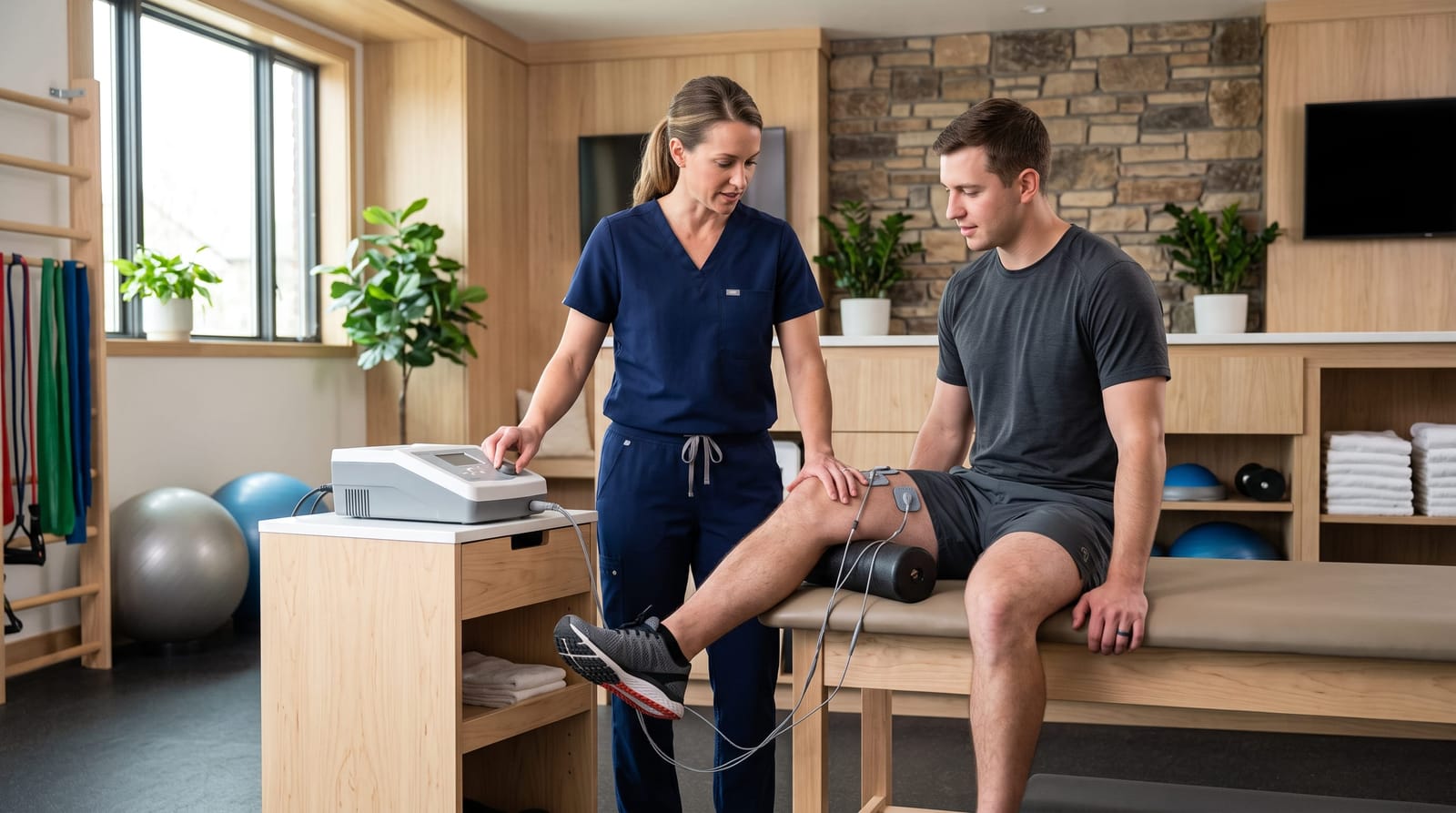
ARPWave technology is specifically designed to interrupt these stuck neurological patterns. The electrical waveform used penetrates deeply into the tissue and activates the nervous system in a way that encourages proper muscle firing sequences. Sessions are typically active, the individual performs movement patterns while the stimulation is applied, which trains the nervous system to accept normal load and coordinate movement correctly during functional activity, not just while lying still on a table.
Common ACFT Injuries ARPWave Supports
- Lower back strain from deadlift training: Heavy 3-rep max attempts place enormous demand on the lumbar erectors, glutes, and hamstrings. When movement patterns break down under fatigue, strain is common. For a deeper look at how ARPWave specifically addresses this, see our post on ARPWave therapy lower back pain deadlift Colorado Springs.
- Knee pain from sprint and drag training: The Sprint-Drag-Carry event is one of the most joint-intensive portions of the ACFT, combining acceleration, lateral drag mechanics, and loaded carry in rapid succession.
- Shoulder and upper back irritation: Volume-based push-up and power throw training frequently creates anterior shoulder overuse patterns, particularly when thoracic mobility is limited.
- Hip flexor and groin strain: Lateral shuffle work, sprint mechanics, and the leg tuck demand significant hip mobility and dynamic stability.
ARPWave sessions at a qualified facility are typically short, often 30 to 45 minutes, and many individuals report noticing differences in how a movement feels within the first few sessions. However, individual responses vary, and this technology is a complement to, not a replacement for, guidance from qualified healthcare providers. Always consult with a licensed medical professional regarding any injury before beginning any recovery program.
What Is Hyperbaric Oxygen Therapy (HBOT) and Why Do Athletes Use It?
Hyperbaric Oxygen Therapy involves breathing concentrated oxygen inside a pressurized chamber, typically at 1.5 to 3 times normal atmospheric pressure. This elevated pressure allows oxygen to dissolve more efficiently into blood plasma and reach tissues that may have reduced circulation: a key factor in recovery from soft tissue injuries, inflammation, and training-related fatigue.
The Science of Oxygen and Tissue Repair
Healing at the cellular level is an oxygen-dependent process. When tissue is damaged, whether from a muscle tear, joint stress, or intense training load, the inflammatory response reduces local blood flow to the area, creating a temporary oxygen deficit that can slow repair. HBOT works by dramatically increasing the amount of dissolved oxygen available in the bloodstream, supporting the body's natural tissue repair mechanisms even in areas with compromised circulation.
Several studies on HBOT in athletic and military contexts suggest it may support reductions in inflammation markers, accelerated soft tissue healing timelines, and improved functional recovery following musculoskeletal injuries. One widely cited area of research involves its application following orthopedic injuries, where oxygen availability is central to collagen synthesis and tissue remodeling: processes essential for returning injured muscles and tendons to full function.
HBOT in Military Fitness Recovery
For soldiers training toward the ACFT, training timelines are rarely flexible. A six-week recovery window that might be acceptable in a recreational context can have serious career and readiness implications for active duty personnel. HBOT's appeal in military fitness contexts is its potential to support the body's natural recovery speed, not by bypassing proper healing, but by optimizing the physiological environment in which healing occurs.
HBOT sessions are typically 60 to 90 minutes in duration. Many athletes and soldiers use it as a complement to active recovery work, ARPWave sessions, and structured return-to-training programming. It is not a standalone solution but rather one component of a comprehensive recovery approach. As always, consult with a licensed healthcare professional to determine whether HBOT is appropriate for your specific situation.
Combining ARPWave and HBOT: A Synergistic Recovery Approach
Used together, ARPWave and HBOT address recovery from complementary angles. ARPWave works on the neurological and muscular coordination side: ensuring that muscles are firing correctly, movement patterns are restored, and the body is no longer compensating around a dysfunctional area. HBOT works on the cellular and physiological side: supporting tissue repair, reducing systemic inflammation, and improving oxygen availability to healing structures.
Think of it this way: HBOT helps rebuild the physical tissue while ARPWave retrains the nervous system to use that tissue correctly. Addressing only one side of this equation is why so many soldiers find themselves re-injured after what seemed like a complete recovery. The structural damage may have resolved, but the compensatory movement pattern often persists, and it's that pattern that sets the stage for the next injury.
A structured program combining both modalities, ideally guided by certified professionals familiar with military fitness demands, creates a more complete return-to-training pathway. This is especially important for soldiers preparing for the ACFT, where all six events must be executed at a high level within the same testing window. Our complete guide on ACFT training events breakdown Colorado Springs outlines the physical demands of each event: understanding those demands helps prioritize recovery efforts appropriately.
Staying Active During Recovery: Training on Profile
One of the most common, and understandable, frustrations soldiers express during injury recovery is the sense that they're falling behind. Training timelines feel urgent, and extended rest feels like lost ground. The reality is that structured, modified training during recovery is often not only possible but actively beneficial for maintaining fitness and supporting the recovery process itself.
The key is working within appropriate limitations while continuing to build the fitness capacities that aren't directly affected by the injury. A soldier with a lower back strain from deadlift training may still be able to maintain upper body strength work, aerobic base conditioning, and mobility. A knee injury doesn't necessarily eliminate core development or grip training.
For soldiers wondering how to navigate ACFT preparation while managing an injury or working under a physical profile, our detailed post on ACFT training on profile injury recovery Colorado Springs addresses this directly, including how to structure modified training blocks that maintain readiness without compromising recovery.
It's also worth noting that poor ACFT deadlift training program Colorado Springs technique is one of the leading contributors to lumbar injuries in ACFT prep. Working with a qualified coach to address movement mechanics, not just adding weight, is one of the most effective long-term injury prevention strategies available.
Why Monument, CO Soldiers Choose Total Body Works for Recovery Support
Total Body Works is located in Colorado Springs, just minutes from Fort Carson and the Air Force Academy, and specifically serves military personnel, veterans, and fitness-focused adults in the Colorado Springs region. The facility combines ARPWave neuro-therapy and HBOT with professional coaching expertise, creating a recovery-focused environment that understands the unique demands and timelines that military service members face.
For soldiers managing ACFT injury recovery in Colorado Springs, ARPWave and HBOT sessions are available as part of an integrated approach that connects recovery work directly to return-to-training programming. The goal is never simply pain reduction in isolation: it's restored function, movement confidence, and the ability to train hard again with appropriate preparation.
The broader context of ACFT conditioning also matters during recovery. Understanding how events like the Sprint-Drag-Carry stress the body helps inform smarter training decisions on both sides of an injury. Our resource on ACFT conditioning sprint drag carry training provides detailed programming guidance that can be adapted for modified training phases.
Related Topics Worth Exploring
If you're dealing with a specific injury or navigating ACFT prep during a recovery period, two additional resources from this series go deeper on these exact situations:
- ARPWave therapy lower back pain deadlift Colorado Springs: A focused look at how ARPWave specifically addresses lumbar strain patterns created by heavy deadlift training, one of the most common ACFT-related complaints.
- ACFT training on profile injury recovery Colorado Springs: A practical guide to structuring ACFT preparation when you're working under a physical profile or managing an active injury.
Getting Back to the Standard: Key Takeaways
ACFT training injuries are a real and common challenge for soldiers at every fitness level. Back pain from deadlifts, knee stress from sprint work, and shoulder fatigue from push-up volume don't have to mean weeks of complete inactivity. ARPWave neuro-therapy and Hyperbaric Oxygen Therapy offer two distinct, complementary approaches to supporting the body's natural recovery process: addressing both the neurological and physiological dimensions of injury rehabilitation.
Used together, under the guidance of qualified professionals, these tools can support a faster, more complete return to full training capacity. If you're currently managing an ACFT-related injury and want to explore how ARPWave and HBOT might support your recovery, reach out to the team at Total Body Works in Colorado Springs. Let's build a recovery approach that gets you back on the platform, and past your next ACFT, with confidence.