The Best Exercises to Increase Your ACFT Deadlift 3-Rep Max
The 3-Rep Max Deadlift (MDL) opens the Army Combat Fitness Test, and it sets the tone for everything that follows. Performed with a 60-pound hex bar loaded with additional plates, it demands explosive posterior chain strength, solid hip mechanics, and full-body stability. If you are searching for the best exercises to increase ACFT deadlift max performance, you are in the right place. This guide covers the most effective movements, the training logic behind each one, and how to build a progressive program that delivers real results. At Total Body Works, our certified coaches have helped hundreds of soldiers and fitness clients raise their MDL scores using exactly these methods.
Why Choosing the Right Exercises to Increase ACFT Deadlift Max Performance Actually Matters
Not all strength training transfers equally to the ACFT deadlift. The MDL rewards hip-dominant power: the ability to drive force through the floor while holding a neutral spine. Your training must prioritize movements that load the hamstrings, glutes, and lower back in patterns similar to the hex bar deadlift. It also needs to build the core stability required to stay safe and strong under heavy load.
Soldiers scoring at the top of the MDL scale, 340 pounds or more for maximum points in many age and gender brackets, do not get there by accident. They follow structured programs built around a primary deadlift variation, targeted posterior chain accessory work, and deliberate hip hinge skill development. According to U.S. Army research published alongside the ACFT rollout, strength-based events like the MDL are among the strongest predictors of overall combat readiness. Knowing which exercises increase ACFT deadlift max scores most efficiently is not just useful: it is essential for competitive performance.
The minimum MDL standard is 140 pounds, while the maximum score threshold varies by gender and age category. Knowing where you fall in that range helps you set realistic, progressive training goals. The coaches at Total Body Works use this scoring context to build individualized plans from day one, ensuring every client trains with purpose and direction.
One more critical point: specificity matters. Generic lower-body training programs rarely produce the same gains as a plan designed specifically around exercises to increase ACFT deadlift max output. The difference between a generalized gym routine and a targeted MDL program can mean 20 to 40 additional pounds on your 3-rep max within a single training block.
Trap Bar Deadlifts: The Foundation of Every Exercises to Increase ACFT Deadlift Max Program
Because the ACFT uses a hex bar, training with the same implement is one of the smartest decisions you can make. The trap bar lets you stand inside the load rather than behind it. This reduces shear stress on the lower spine and makes it easier to maintain proper alignment, especially important when building toward heavy 3-rep efforts. A 2020 study in the Journal of Human Kinetics found that trap bar deadlifts produced greater peak force and peak power output than straight-bar deadlifts. That makes them a superior choice for athletes focused on maximal strength expression.
Structuring your trap bar work correctly is one of the most effective exercises to increase ACFT deadlift max scores across all fitness levels. Dedicate one training day per week to trap bar deadlifts as your primary movement. Work up gradually to a heavy set of 3 to 5 reps. Then drop back to 2 to 3 moderate-weight sets of 5 to 8 reps. This combination builds maximal strength and the muscular endurance that supports it session after session.
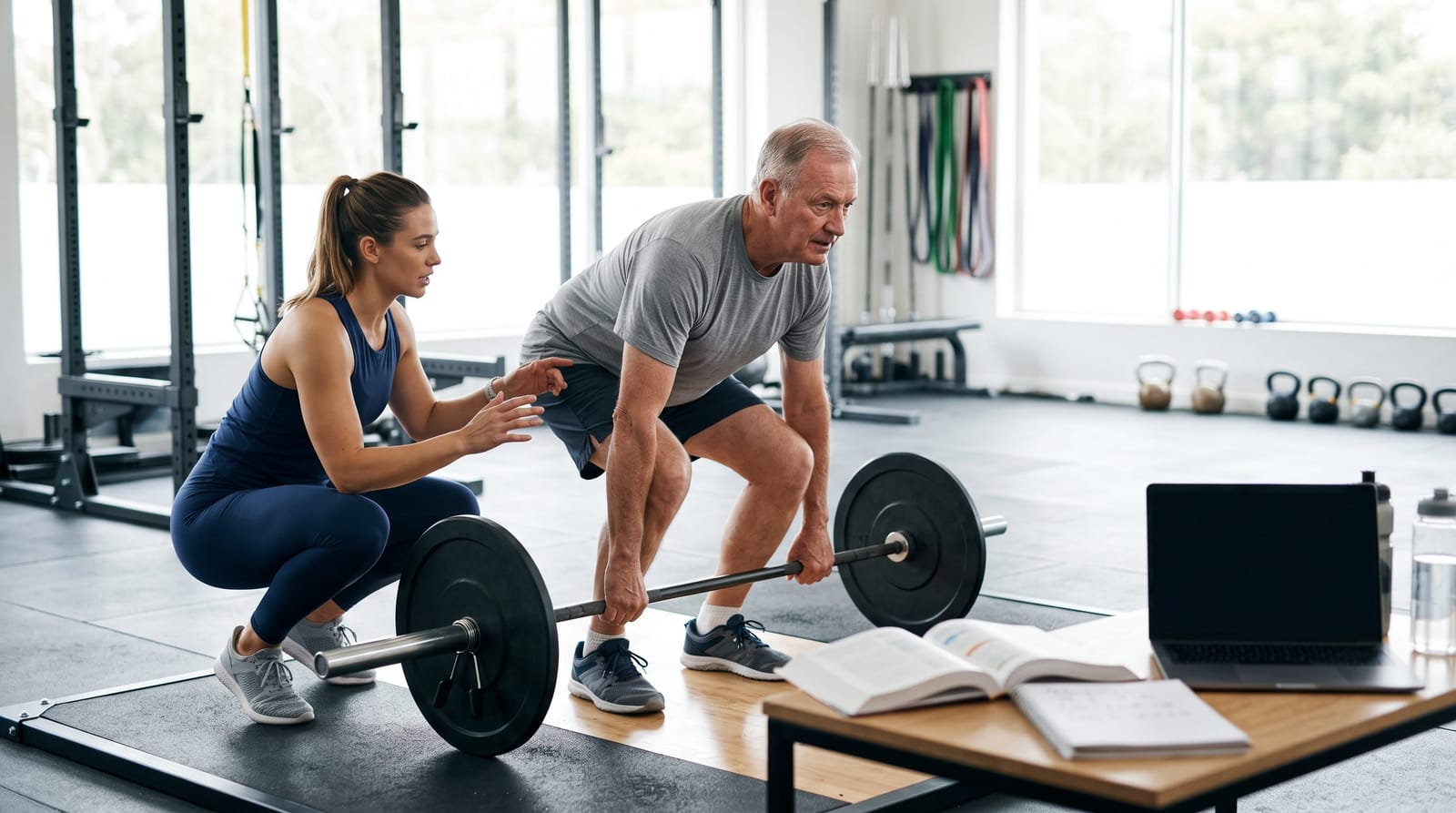
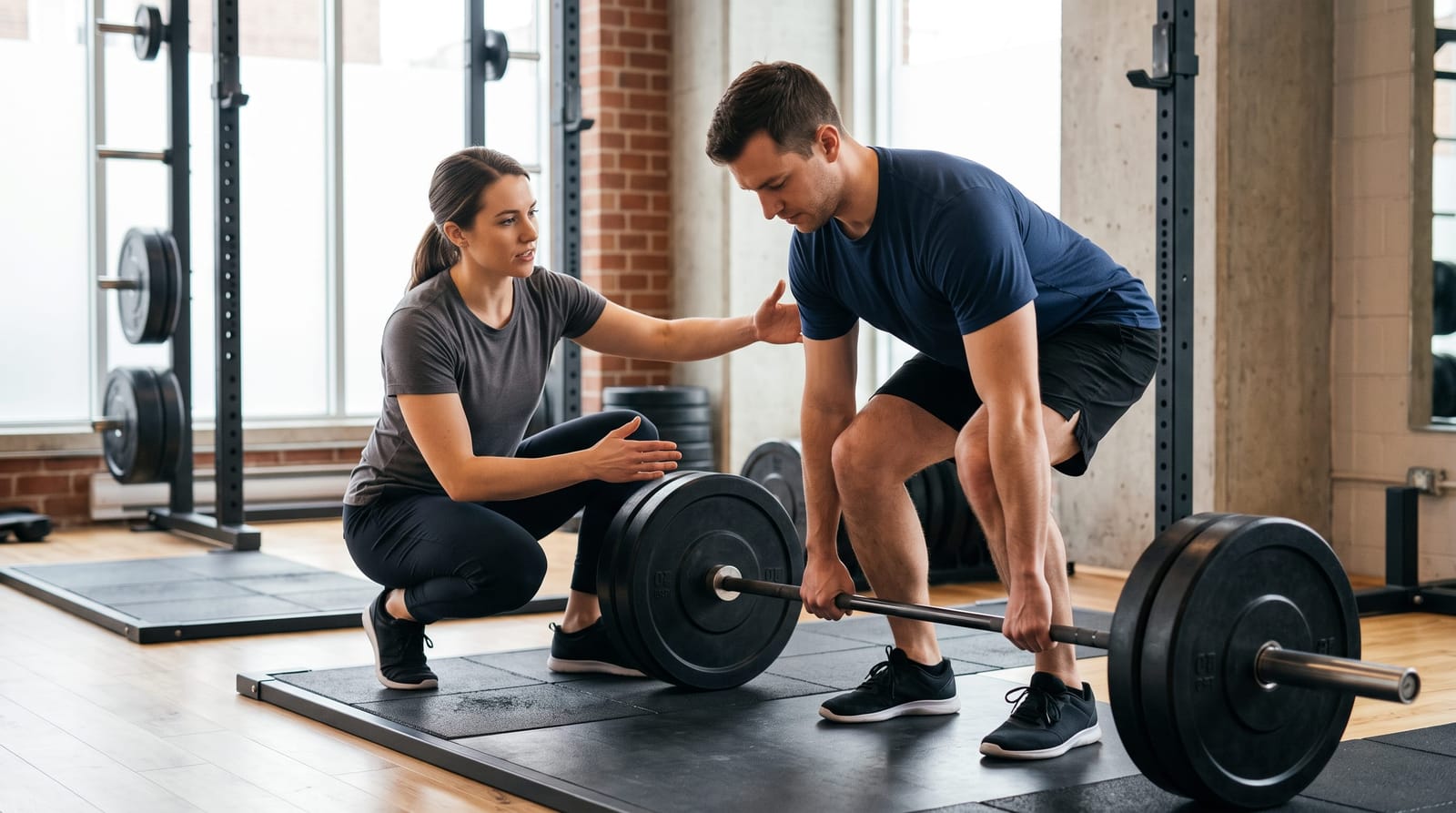
Rushing past poor form to add weight is one of the most common and costly mistakes soldiers make. Trainers at Total Body Works conduct technique reviews at every session. Sustainable progress depends on moving well before moving heavy, and there are no shortcuts around this principle.
Key Technique Cues for Every Trap Bar Set
Dialing in your mechanics on every rep compounds over time. Use these cues consistently to reinforce proper movement patterns under load:
- Feet hip-width apart, centered inside the bar
- Hips hinge back before the knees bend, not the other way around
- Chest tall, shoulder blades pulled together and set before the pull
- Drive through the floor: think "push the ground away" rather than "pull the bar up"
- Lock out fully at the top with hips forward, not hyperextended
- Control the descent: do not drop the bar between reps
- Reset your brace and your breath before each new rep
These cues are not just beginner reminders. Even experienced lifters drift away from ideal mechanics as fatigue accumulates. Reviewing them before every working set keeps your training honest and your progress moving forward.
How to Progress Trap Bar Deadlift Weight Over Time
Load progression is the engine behind long-term MDL improvement. Add 5 pounds to your trap bar every one to two weeks when you complete all reps with clean form. This rate, roughly 5 to 10 pounds per month, is realistic and sustainable without the injury risk that comes from rushing. Over a 12-week training block, that translates to a potential 30 to 60 pound improvement in your working max, before accounting for the additional strength built through accessory exercises to increase ACFT deadlift max output.
Romanian Deadlifts and Deficit Variations: Posterior Chain Exercises to Increase ACFT Deadlift Max
The Romanian Deadlift (RDL) is arguably the most valuable accessory movement for soldiers focused on exercises to increase ACFT deadlift max scores. It isolates the hamstrings and glutes through a controlled hip hinge: training exactly the muscles that drive the hex bar off the floor. Unlike the full deadlift, the bar never touches the ground. You lower it to mid-shin while keeping your back flat and hips pushing back, then drive forward to stand.
Deficit Romanian deadlifts add an extra challenge on a second training day each week. Standing on a 2 to 4 inch platform increases the range of motion and recruits the hamstrings through a longer stretch. Field-tested strength programs, including protocols used at Total Body Works with active-duty soldiers, consistently identify this variation as a key driver for pushing MDL scores past the midpoint of a scoring bracket. Research on eccentric hamstring loading confirms this, showing that longer-range hamstring work increases both strength output and injury resistance over time.
Recommended Rep Ranges for RDL Accessory Work
Getting volume and intensity right matters just as much as choosing the right movement. These rep ranges work well for most soldiers and clients building toward an MDL improvement goal:
- 3 to 4 sets of 8 to 12 reps at moderate weight (60 to 70% of your deadlift max)
- Slow, controlled lowering: 3 seconds down, 1 second pause at the bottom, then drive up
- Increase weight by 5 to 10 pounds every two weeks as technique stays clean
- Use a hip hinge cue before each set to reinforce movement quality
- Rest 90 seconds to 2 minutes between sets to maintain output quality
Clients at Total Body Works who add consistent RDL work to their programs typically report 10 to 20 percent improvements in their trap bar deadlift over an 8-week training block. This tracks closely with published research on accessory movement transfer to primary lifts.
Hip Hinge Drills and Core Stability: Foundational Exercises to Increase ACFT Deadlift Max
Strength without movement quality has a ceiling. If a soldier cannot reliably hinge at the hip, separating hip movement from spinal flexion, adding weight only reinforces poor patterns. These foundational exercises to increase ACFT deadlift max performance address movement quality at its most basic level. They are especially useful for anyone newer to deadlift training or returning after a break or injury.
A landmark study in the Journal of Orthopaedic and Sports Physical Therapy found that athletes who received targeted hip hinge instruction improved deadlift performance by an average of 18 percent over six weeks, without increasing load. That is a powerful reminder that movement skill is a form of strength, and it transfers directly to the ACFT.
Hip Hinge Drills That Build Deadlift Mechanics
Simple but highly effective drills include the dowel rod hinge, the band-resisted hinge, and the single-leg RDL with bodyweight. The dowel rod hinge involves holding a rod against your spine to feel neutral alignment while you practice pushing the hips back. These movements teach the nervous system what a proper hinge pattern feels like. When heavier loads are added later, the movement becomes more consistent and more productive. At Total Body Works, every new client beginning an MDL training block starts with at least two weeks of dedicated hip hinge drill work before progressing to loaded exercises to increase ACFT deadlift max strength.
Core Stability Exercises That Transfer Directly to the MDL
The ACFT deadlift requires your core to act as a rigid transfer zone between your lower body power and the bar. Weak or poorly activated core muscles allow energy to leak out of the lift and raise injury risk significantly. Prioritize anti-extension and anti-rotation exercises over traditional crunches, which have limited carry-over to heavy lifting performance. The following core exercises to increase ACFT deadlift max output belong in every training block:
- Plank variations: standard plank, RKC plank, and weighted planks (30 to 60 seconds per set)
- Dead bugs: 3 sets of 8 to 10 reps per side, keeping the lower back in full contact with the floor throughout
- Pallof press: 3 sets of 10 reps per side using a band or cable machine
- Suitcase carries: 40 meters with a kettlebell in one hand, then switch sides
- Farmer carries: 2 to 3 sets of 30 to 40 meters with heavy dumbbells held at your sides
- Bird dogs: 3 sets of 10 reps per side, held 2 to 3 seconds at full extension
Core stability training is consistently undervalued by soldiers chasing raw strength numbers. Athletes who sustain long-term MDL progress almost always have the strongest mid-body bracing ability. These are not optional extras: they are critical exercises to increase ACFT deadlift max results that anchor every well-designed program.
Explosive Movements: Complementary Exercises to Increase ACFT Deadlift Max Speed and Power
Beyond primary deadlift work and direct accessory movements, several complementary exercises accelerate MDL progress by building explosive hip extension, single-leg stability, and full-body conditioning. These movements target qualities that heavy barbell work alone cannot fully develop. Incorporating them alongside your main exercises to increase ACFT deadlift max strength creates a more complete and resilient athlete.
Kettlebell swings train the ballistic hip snap critical for generating force off the floor at the start of each deadlift rep. Even 3 sets of 15 to 20 reps with a moderate kettlebell, 35 to 53 pounds for most soldiers, builds the fast-twitch muscle recruitment that separates average lifters from high scorers. A study in the Journal of Strength and Conditioning Research found that 6 weeks of kettlebell swing training significantly improved deadlift performance in trained athletes. This makes swings one of the highest-return exercises to increase ACFT deadlift max explosiveness available.
Lunges and step-ups address single-leg strength and balance. Many soldiers have strength imbalances between their left and right sides that only become apparent under heavy loads. Unilateral work corrects this over time and reduces the injury risk that unbalanced loading creates. Step-up variations also closely mimic the hip extension pattern of the deadlift lockout.
Sled pushes build lower-body drive in a position similar to the final lockout of the deadlift. They develop conditioning without taxing the lower back as much as additional barbell volume. Two 20-meter pushes at the end of a training session, once or twice per week, add meaningful stimulus without creating excessive fatigue or recovery debt.
Box squats develop hip-crease depth and glute activation from a dead stop: a quality directly transferable to breaking the bar off the floor in the MDL. They pair well with trap bar deadlift days as a secondary movement performed at moderate loads. Box squats are a frequently overlooked addition to exercises to increase ACFT deadlift max programs, yet they consistently drive improvements in starting strength.
Common Programming Mistakes That Limit Exercises to Increase ACFT Deadlift Max Results
Knowing the right exercises is only half the equation. Understanding what derails progress is equally important. These are the most common mistakes soldiers and fitness clients make when trying to improve their MDL score.
- Training too heavy too soon: Jumping to maximal loads before technique is solid leads to compensations, stalled progress, and injury. Build form first, then build weight on top of it.
- Skipping accessory work: Many soldiers focus exclusively on the trap bar deadlift and neglect the RDL, core, and hip hinge drills that support it. Accessory exercises to increase ACFT deadlift max strength are not optional: they are what make the primary lift grow.
- Inconsistent training frequency: Strength adaptation requires consistent stimulus. Training the deadlift once every two weeks produces far less improvement than two focused sessions per week with proper recovery between them.
- Ignoring recovery: Sleep deprivation and chronic stress blunt strength gains at the hormonal level. Research from the U.S. Army Research Institute consistently links poor sleep quality with reduced strength performance on fitness evaluations, including the ACFT.
- No progressive overload: Lifting the same weight for the same reps week after week produces no new adaptation. Your exercises to increase ACFT deadlift max output must become progressively more challenging over time to drive continued improvement.
The coaches at Total Body Works flag these issues during program reviews and check-ins. Catching and correcting these patterns early is one of the clearest advantages of working with a qualified trainer over training alone.
How Total Body Works Programs Exercises to Increase ACFT Deadlift Max Scores
At Total Body Works, programming for the MDL is built around three core principles: specificity, progressive overload, and recovery management. Every program begins with a movement assessment to identify form weaknesses and strength imbalances. From there, training is structured across two to three days per week using the exercises described in this guide, with load, volume, and intensity adjusted every two to four weeks.
Our clients, including active-duty soldiers, reservists, and fitness-focused civilians preparing for military service, consistently report 15 to 30 pound increases in their 3-rep max within the first 8 to 12 weeks of structured training. That kind of improvement can mean the difference between a failing score and a competitive one, or between a passing score and a maximum. Working with a certified trainer who understands both military fitness standards and strength programming principles is the most reliable path to reaching your MDL goal on a defined timeline.
"I went from 220 to 280 pounds on the MDL in 10 weeks," says Staff Sergeant Marcus T., a Total Body Works client who completed our MDL-focused training block before his unit's ACFT cycle. "The combination of trap bar work, RDLs, and the core drills made a bigger difference than anything I had tried before." Stories like this reflect the consistent outcomes we see when structured exercises to increase ACFT deadlift max performance are applied with discipline and proper coaching.
Programming Logic: How to Structure Exercises to Increase ACFT Deadlift Max Over Time
Consistency and gradual progression are the two most important variables in any strength program. The goal is to give your body slightly more challenge than it faced last week, not dramatically more. This principle, called progressive overload, drives every successful MDL improvement program. Here is a practical weekly structure using the exercises to increase ACFT deadlift max outlined throughout this guide:
- Day 1: Heavy Strength Day: Trap bar deadlift (warm-up sets, 1 heavy set of 3 to 5 reps, 2 to 3 back-off sets of 5 to 8 reps). Box squats (3 sets of 5 to 6 reps). Core stability work: planks, dead bugs, Pallof press.
- Day 2: Accessory and Volume Day: Deficit Romanian deadlifts (4 sets of 8 to 10 reps). Hip hinge drills (2 to 3 sets). Kettlebell swings (3 sets of 15 to 20 reps). Suitcase or farmer carries (2 to 3 sets).
- Day 3: Optional Conditioning Day: Sled pushes (4 sets of 20 meters). Lunges or step-ups (3 sets of 12 per leg). Single-leg RDL work for reinforcement and symmetry. Bird dogs and dead bugs for movement quality maintenance.
Add 5 pounds to your trap bar work every one to two weeks when you complete all reps with clean form. Over a 12-week block, that translates to a 30 to 60 pound improvement in your working max, before accounting for the additional strength built through the accessory exercises to increase ACFT deadlift max output described here.
Working with a qualified personal trainer who understands military fitness standards adds significant value at every stage. The certified coaches at Total Body Works provide real-time form feedback, adjust programming when progress stalls, and help clients navigate the balance between training hard and recovering well. Plateaus are not dead ends: they are programming problems, and experienced coaches solve them faster than self-directed training allows.
Nutrition and Recovery: Supporting Your Exercises to Increase ACFT Deadlift Max Progress
Even the best exercises to increase ACFT deadlift max strength will underperform if nutrition and recovery are neglected. Strength adaptation is a biological process, and the body builds muscle and connective tissue during rest, not during the workout itself. Supporting that process nutritionally is a non-negotiable part of any serious MDL improvement program.
Protein intake is the most important nutritional variable for strength-focused training. Research from the International Society of Sports Nutrition recommends 1.6 to 2.2 grams of protein per kilogram of body weight per day for athletes focused on strength development. For a 180-pound soldier, that means consuming between 130 and 180 grams of protein daily from whole food sources like chicken, eggs, fish, Greek yogurt, and legumes.
Carbohydrates fuel the heavy training sessions that drive MDL improvement. Prioritize complex carbohydrate sources, rice, oats, sweet potatoes, and fruit, around your training windows. Eating a moderate carbohydrate meal 90 minutes before training and including protein and carbohydrates in your post-workout meal within 60 minutes of finishing significantly improves recovery between sessions.
Sleep is the single most underutilized recovery tool available. Studies from the Journal of Sleep Research show that athletes sleeping fewer than 7 hours per night experience measurable reductions in strength output and training adaptation. Soldiers and clients at Total Body Works are consistently reminded: the exercises to increase ACFT deadlift max performance only work as well as your recovery allows them to.
Frequently Asked Questions About Exercises to Increase ACFT Deadlift Max
How many times per week should I train exercises to increase ACFT deadlift max strength?
Two to three focused sessions per week targeting the posterior chain is a practical starting point for most soldiers. One day should prioritize heavy trap bar deadlifts. A second day should focus on Romanian deadlifts and accessory work. A third optional session can include conditioning-focused movements like sled pushes and kettlebell swings. Recovery between sessions matters as much as the training itself: most strength adaptations happen during rest, not during the workout.
How long does it take to see meaningful improvement in my 3-rep max?
With consistent training and proper programming, many soldiers see measurable strength gains within 6 to 8 weeks. The rate of progress depends on your starting point, training consistency, sleep quality, and overall recovery. Soldiers newer to structured deadlift training often see faster early gains. More experienced lifters may progress more gradually but can still achieve significant improvements with well-designed exercises to increase ACFT deadlift max performance over a 12-week block.
Is the trap bar the same as the hex bar used in the ACFT?
Yes: the terms are interchangeable. The ACFT specifies a 60-pound hex bar as the starting implement. Training with a trap bar in the gym closely replicates the grip position, stance, and mechanics of the actual test. This makes it the most specific and transfer-rich training tool available for soldiers working on their MDL score. Prioritizing trap bar deadlifts in your exercises to increase ACFT deadlift max program is a direct investment in test-day performance.
Should I train the deadlift if I have lower back soreness after workouts?
Mild muscle fatigue in the lower back after deadlift training is normal, especially early in a new program. However, sharp, persistent, or worsening discomfort is a signal to stop and consult a qualified healthcare provider before continuing. A certified trainer can also assess your technique to identify whether form corrections might reduce unnecessary strain. The coaches at Total Body Works perform movement screenings specifically to catch these issues early. Never train through pain: doing so turns a correctable problem into a serious setback.
Building Your ACFT Deadlift Max: One Rep at a Time
Improving your ACFT 3-Rep Max Deadlift is a process that rewards patience, consistency, and smart exercise selection. The exercises to increase ACFT deadlift max performance covered in this guide, trap bar deadlifts, Romanian deadlift variations, hip hinge drills, core stability work, explosive kettlebell movements, and complementary conditioning exercises, form a complete, evidence-based system for meaningful progress. Whether you are working toward the minimum standard or pushing for a maximum score, the right exercises to increase your ACFT deadlift max are available to you starting with your very next training session.
Do not leave your MDL score to chance. The difference between a soldier who improves steadily and one who plateaus almost always comes down to program quality and coaching consistency. The exercises to increase ACFT deadlift max output described here are proven, but they work best when applied within a structured, progressive plan built around your specific starting point and timeline.
At Total Body Works, we specialize in helping personal training professionals and their clients build exactly this kind of results-focused program. Our certified coaches understand the ACFT scoring system, the demands of military fitness, and the strength training principles that drive real-world performance improvement. If you are ready to stop guessing and start progressing on your exercises to increase ACFT deadlift max results, reach out to the Total Body Works team today and take the first step toward a stronger MDL score.