Can You Transform Your Body After 50? Real Expectations and Real Results

If you're over 50 and wondering whether real, measurable body transformation is still possible for you: the short answer is yes. Not "yes, but…" or "yes, if you were younger." Just yes. The longer answer involves understanding what's actually happening in your body, what challenges are worth addressing head-on, and why mature adults often outperform younger clients in structured transformation programs. This post gives you the honest, evidence-backed picture so you can move forward with confidence rather than guesswork.
What Physiology Actually Says About Body Transformation After 50
Your body at 50, 60, or even 70 is not broken: it's different. Understanding those differences is the first step toward working with your biology instead of against it.
The primary physiological shifts that affect body transformation after 50 include:
- Declining anabolic hormones: Testosterone and growth hormone decrease significantly from peak levels. In men, testosterone typically drops 1-2% per year after 30. In women, menopause accelerates changes in estrogen that affect fat distribution and muscle retention.
- Sarcopenia: Without deliberate resistance training, adults lose 3-8% of muscle mass per decade after 30, with the rate accelerating after 60. This is not inevitable: it's preventable and largely reversible.
- Reduced recovery capacity: Muscle protein synthesis takes longer to peak and sustain after resistance training compared to younger adults, meaning rest and programming precision matter more, not less.
- Insulin sensitivity changes: Metabolic efficiency shifts with age, making nutrition quality and meal timing more impactful factors in body composition.
Here's what those facts don't mean: they don't mean transformation is out of reach. They mean your program needs to be designed by someone who understands these variables, not a generic app or a one-size-fits-all bootcamp. When programming accounts for recovery, hormone status, and training age, the results speak for themselves.
Real-World Results: What's Possible at 50, 60, and Beyond
The skepticism about body transformation after 50 often comes from comparing results to a 25-year-old, which is the wrong comparison entirely. The right question is: what are people in your demographic actually achieving?
The fitness world has produced compelling examples. Charlene Leibel is a frequently cited case of a woman who, well into her 70s, made measurable gains in muscle mass through structured, progressive resistance training. Her results weren't modest improvements: they were substantive changes in body composition that her doctors could measure.
The famous Colorado Experiment, while originally designed around a younger competitive athlete recovering from injury, demonstrated something relevant to every age group: the human body's capacity to rebuild muscle is far greater than most people assume, and the rate of change possible in a short, focused window is genuinely surprising. The takeaway isn't that you'll replicate those specific numbers: it's that physiological adaptation doesn't simply stop with age.
In Colorado Springs specifically, programs designed for the 50+ demographic consistently see clients achieve:
- 8-15 pounds of fat loss in 12-16 weeks when nutrition is addressed alongside training
- Measurable increases in lean muscle mass within 8-12 weeks of consistent resistance training
- Meaningful improvements in functional strength, posture, and mobility that translate directly to quality of life
- Reduced joint pain and improved movement patterns, often an unexpected but deeply valued outcome
Understanding how long does body transformation take Colorado Springs is an important part of setting realistic expectations, and the timeline for over-50 clients is often more comparable to younger clients than people expect when programming is dialed in correctly.
The Unique Advantages Mature Adults Bring to a Transformation Program
Here's what's rarely talked about: adults over 50 often make better transformation clients than people half their age. This isn't motivational spin: it's an observation consistently reported by experienced personal trainers who work across age groups.
The reasons are straightforward:
- Motivation is real and internal. You're not training to look good at a party. You're training because your knees hurt, your energy is declining, your doctor said something that concerned you, or you watched a parent lose their independence. That kind of motivation doesn't skip sessions.
- Discipline is already developed. You've managed a career, a household, and decades of adult responsibility. Showing up consistently and following a structured plan is something you've been doing your whole life.
- You know yourself. Younger clients often fight the process, second-guess their trainer, or chase shortcuts. Mature clients tend to trust expertise, communicate honestly about their body, and commit to the work.
- Sleep and recovery are taken seriously. When a trainer explains why rest matters, a 55-year-old client typically prioritizes it. A 25-year-old client is more likely to stay out late and think they can push through.
These advantages don't eliminate the physiological challenges, but they often more than compensate for them, especially in a well-designed, individually coached program.
What a Smart Over-50 Transformation Program Looks Like
Not all training programs are designed with mature physiology in mind, and this is where many over-50 clients have failed in the past, not because they weren't capable, but because the program wasn't built for them.
A program designed for body transformation over 50 should include:
- Progressive resistance training as the foundation. Cardio alone does not rebuild muscle or shift body composition meaningfully. Resistance training, structured, progressive, and technically coached, is non-negotiable.
- Adequate protein targeting. Research consistently shows that older adults need more dietary protein per pound of body weight, not less, to stimulate muscle protein synthesis. A qualified coach will set specific targets, not generic guidelines.
- Recovery built into the schedule. More isn't better after 50. Optimal training frequency with intentional recovery windows produces better results than high-volume approaches that compromise sleep and increase injury risk.
- Mobility and joint health integrated, not treated as an afterthought. Movement quality directly affects training performance and longevity in the program.
- Regular reassessment. Body composition, strength benchmarks, and energy levels should be tracked and used to adjust the program. What works in month one may need adjustment in month three.
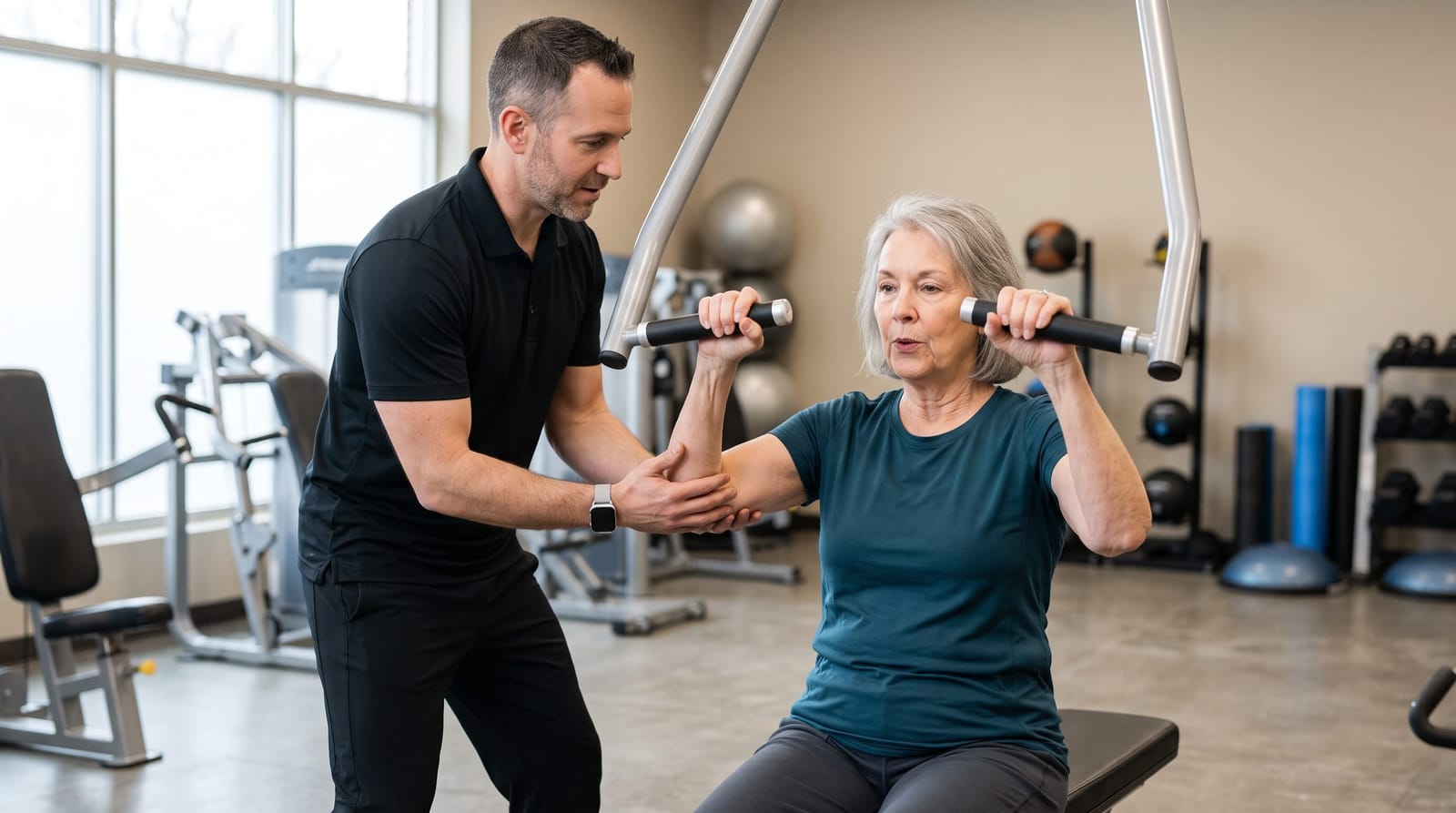
Private one-on-one coaching is particularly valuable here. Group classes and self-directed gym routines rarely provide the individualized programming, form correction, and accountability that produce consistent results in this demographic.
Frequently Asked Questions
How long will it take to see results from a body transformation program after 50?
Most clients over 50 begin noticing measurable changes, improved energy, reduced bloating, early strength gains, within the first 3-4 weeks. Visible body composition changes typically emerge between weeks 6 and 12, depending on starting point, program quality, and nutritional adherence. Full transformation milestones are often set at 12-20 weeks in professionally designed programs.
Is it safe to do intense resistance training after 50?
Yes, when properly supervised and progressively programmed. The risk of injury in resistance training is directly tied to poor technique and inappropriate loading, not age. In fact, the greater risk for adults over 50 is not training: sedentary behavior accelerates bone density loss, muscle wasting, and metabolic decline. A qualified private trainer who performs a proper intake assessment will design intensity levels that challenge without compromising safety.
Do I need to change my diet significantly to see results?
Nutrition is essential, but "significantly changing your diet" doesn't have to mean restriction or deprivation. For most over-50 clients, the most impactful changes are increasing protein intake, improving meal quality, and managing eating patterns, not dramatic calorie cutting, which can accelerate muscle loss in mature adults.
What if I have injuries or chronic pain: can I still do a transformation program?
Many over-50 clients enter programs with existing joint issues, past surgeries, or chronic pain. A qualified private personal trainer in Colorado Springs should be able to design around these limitations rather than use them as a disqualifier. In many cases, structured movement and strength training actually reduces chronic pain over time by improving joint stability and reducing inflammation markers.
The Bottom Line
Body transformation after 50 is not only possible: it's happening for real people in Colorado Springs right now. The physiological realities are real, but they don't close the door; they simply require a more thoughtful key. What you bring to a well-designed program, discipline, real motivation, and self-awareness, is exactly what produces results. If you've tried generic fitness approaches before and been underwhelmed, the gap wasn't your age. It was the program. The right structure, the right coaching, and the right expectations change everything.