Power, Speed, and Agility Training for Colorado Athletes: Methods That Actually Transfer to Sport
When it comes to sport-specific performance training in Colorado Springs, raw fitness is rarely the limiting factor. What separates competitive athletes from recreational ones is how well their training translates to the demands of their actual sport: the explosive first step, the reactive change of direction, the sustained power output in the final quarter. Power, speed, and agility training bridges that gap. This guide breaks down the science and practical methods behind athletic development, plyometrics, sprint mechanics, reactive drills, force production, and loaded carries, and explains how each of these tools, when programmed intelligently, produces real results on the field, court, trail, or course. Whether you're a high school athlete, a competitive adult, or a recreational player pushing to stay sharp, understanding these fundamentals will help you train smarter.
Why Power, Speed, and Agility Training Matters More Than You Think
Most athletes train hard. Fewer athletes train specifically. There's a meaningful difference between building general fitness and building sport-transferable athletic qualities, and that difference shows up during competition.
Power is the ability to produce force quickly. Speed is the expression of that power in movement. Agility combines speed with decision-making, allowing an athlete to accelerate, decelerate, and change direction efficiently. Research published in the Journal of Strength and Conditioning Research consistently shows that structured power and speed training programs can improve sprint times by 3-7% and vertical jump height by 5-15% in trained athletes over an 8-12 week training block: improvements that are genuinely meaningful in competitive contexts.
Colorado Springs is home to a unique athletic population, from USOC-affiliated elite competitors to weekend warriors in trail running, soccer, lacrosse, basketball, and cycling. The altitude alone (approximately 6,035 feet above sea level) creates a physiological training environment that demands strategic programming. Oxygen availability at altitude means athletes must manage intensity and recovery more carefully than they would at sea level, making well-structured masters athlete training over 50 Colorado Springs and youth athlete programming even more important in this region.
Understanding performance training vs personal training Colorado Springs helps clarify why general gym work, while valuable, often isn't sufficient for athletes who want to compete at a higher level. Sport performance training is purposeful and position-specific: it's not just about getting stronger or fitter in a general sense.
The Science of Force Production: Building Athletic Power from the Ground Up
Athletic power begins with force production: specifically, how much force your neuromuscular system can generate and how quickly it can do so. This quality is measured by what sports scientists call the rate of force development (RFD), and it's a primary differentiator between explosive athletes and those who feel slow or reactive on the field.
Why the Lower Body Is the Foundation
The majority of athletic movements, sprinting, jumping, cutting, decelerating, are powered by the hips, glutes, and posterior chain. Building strength in these areas through compound movements like trap bar deadlifts, Romanian deadlifts, and single-leg squats creates the raw force capacity that plyometrics and speed work can then express. Studies suggest that athletes who demonstrate higher relative strength (strength relative to body weight) show measurably faster sprint times and greater jump performance compared to their less-trained counterparts.
Loaded Carries as a Power Development Tool
Loaded carries, farmer's carries, suitcase carries, and overhead carries, are underutilized tools in athletic performance programming. They build total-body tension, reinforce upright posture under load, and train the anti-rotational core stability that athletes rely on during physical contact or rapid directional changes. A simple farmer's carry circuit, performed with appropriate load (typically 50-75% of bodyweight per hand for advanced athletes), can improve grip strength, shoulder stability, and gait mechanics simultaneously.
Sprint Mechanics: The Difference Between Running Fast and Training Fast
Speed training isn't just about running more. It's about running better. Sprint mechanics training addresses the technical elements of acceleration and maximum velocity, and it's where athletes of all sports can make some of the fastest measurable gains with proper coaching.
Acceleration Phase (0-10 Yards)
The acceleration phase is the most trainable component of speed for most sport athletes, because very few team sport athletes ever reach true maximum velocity during play. In the first 10 yards, athletes should be driving backward into the ground at a forward lean angle of roughly 45 degrees, generating horizontal force to overcome inertia. Common errors include early upright posture, overstriding, and poor arm drive, all of which bleed power from the movement. Drills like wall drives, resisted sled sprints, and A-skip progressions isolate and correct these mechanics.
Upright Sprint Mechanics and Stride Optimization
Once acceleration transitions to upright running, athletes need to maintain high hip position, proper arm mechanics (90-degree bend, driving elbow back), and ground contact times as brief as possible. Elite sprinters spend roughly 80-90 milliseconds in contact with the ground per stride. While recreational athletes won't reach those numbers, the principle of minimizing ground contact through stiffness training (ankle and calf conditioning) and reactive drills directly improves speed.
Plyometrics and Reactive Training: Teaching the Nervous System to Be Explosive
Plyometric training is one of the most well-researched methods for developing explosive athletic power. The foundational mechanism is the stretch-shortening cycle (SSC): a rapid pre-stretch of the muscle followed by an immediate concentric contraction that amplifies force output, much like a compressed spring releasing energy.
For a deeper breakdown of specific exercises and progressions, our guide to plyometric exercises explosive power training Colorado walks through the full spectrum from entry-level to advanced options.
Progressive Plyometric Programming
Effective plyometric training follows a logical progression:
- Phase 1: Landing Mechanics: Box step-downs, two-leg broad jump landings, and deceleration work build the absorption capacity needed to perform jumps safely and effectively.
- Phase 2: Basic Jumps: Squat jumps, broad jumps, and box jumps develop foundational explosive power with moderate ground contact time.
- Phase 3: Reactive/Plyometric: Depth drops, hurdle hops, and bounding progressions train the reactive strength of the SSC with minimal ground contact time.
- Phase 4: Sport-Specific Application: Lateral bounds, single-leg hops, and rotational med ball throws mirror the movement demands of specific sports.
Reactive Agility Drills
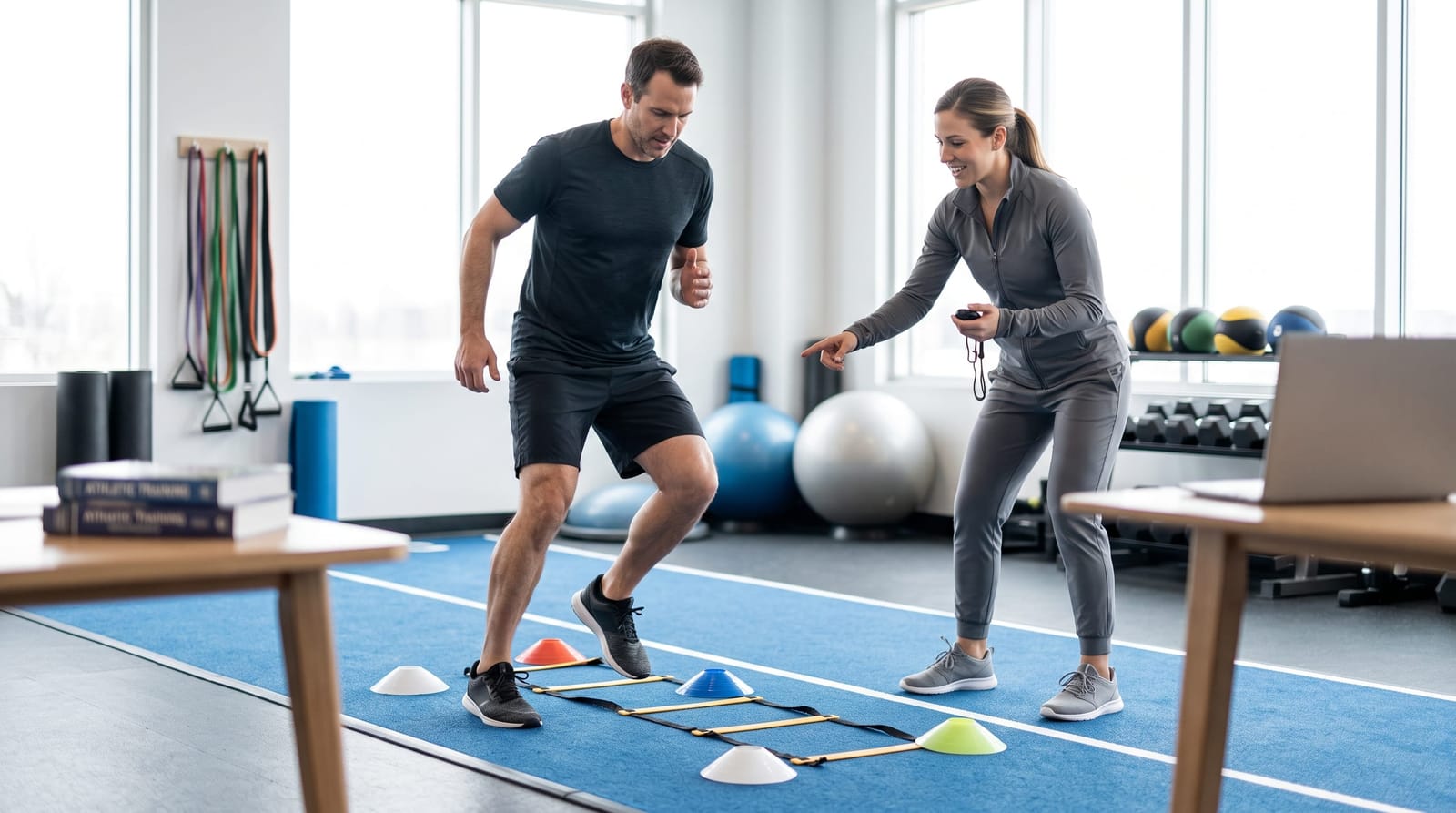
Traditional agility ladder drills and cone patterns are useful for foot speed and coordination, but they're pre-planned, and sport is not. Reactive agility training uses visual or auditory cues to force athletes to respond to unpredictable stimuli, training the cognitive-motor connection that determines true game-speed agility. Examples include mirror drills with a partner, light-reactive systems, and ball-drop reaction work. Research indicates that reactive agility performance is significantly different from pre-planned agility and must be trained separately to transfer to competition.
Integrating Power Speed Agility Training Colorado Springs Athletes Can Actually Use
Effective power speed agility training Colorado Springs athletes rely on isn't a random collection of drills thrown together: it's a structured, periodized system built around each athlete's sport season, competition schedule, and physical capacity.
Training Frequency and Periodization
The question of how much is enough is one of the most common ones coaches encounter. For competitive athletes in-season, 2-3 total training sessions per week outside of practice is generally a sustainable range that maintains athletic qualities without compromising recovery. For athletes in the off-season building a performance base, 3-5 sessions per week across different training qualities may be appropriate depending on overall volume and intensity management. Our detailed breakdown of how many training sessions per week athlete Colorado Springs covers this topic with specific guidance for different athletic contexts.
Programming Priority by Sport Demand
Not all athletes need the same training emphasis. A basketball player needs vertical power and lateral quickness. A soccer player needs repeated sprint capacity and multidirectional agility. A trail runner needs eccentric leg strength and uphill power. An effective sport-specific program identifies the primary physical demands of the sport and positions training methods accordingly, with plyometrics, sprint work, and strength training weighted toward those specific demands.
How Total Body Works Approaches Athletic Performance
At Total Body Works in Colorado Springs, sport-specific performance programming is built around individual assessment first. Athletes are evaluated for movement quality, strength baselines, and sport-specific demands before any training template is applied. Power development, sprint mechanics, reactive agility, and loaded carry work are integrated within a cohesive weekly structure, not bolted on as afterthoughts. This ensures that every session builds toward real, transferable athletic performance rather than just general conditioning.
Common Mistakes Athletes Make in Power, Speed, and Agility Training
Understanding what doesn't work is as valuable as knowing what does. These are the most common errors athletes make when trying to develop these qualities on their own:
- Skipping the strength foundation: Plyometrics performed without an adequate strength base often produce poor results and increase injury risk. General guidance suggests athletes should be able to squat at least 1.5 times their body weight before progressing to high-intensity reactive plyometrics.
- Training speed when fatigued: Speed work requires a fresh nervous system. Performing sprint drills at the end of a heavy strength session means training slow movement patterns, not fast ones. Speed work belongs early in a session or on separate days.
- Relying only on pre-planned agility drills: Ladder drills and cone patterns are tools, not complete solutions. They must be complemented with reactive, decision-based training to transfer into competitive performance.
- Neglecting deceleration: Athletes get hurt when they can't stop as well as they can go. Deceleration training, single-leg landings, lateral stop-and-go work, is as important as acceleration in sport performance programs.
- No periodization: Training the same drills at the same intensity year-round produces diminishing returns. Strategic variation in volume, intensity, and exercise selection drives continued adaptation.
Related Topics Worth Exploring
Power, speed, and agility training is one component of a broader athletic development system. If you're building a complete performance training approach, these related topics offer additional depth:
- Understanding the differences between performance training vs personal training Colorado Springs can help you decide what type of coaching structure best fits your athletic goals.
- If you're an older athlete looking to stay competitive, the principles in this guide apply directly, with specific adaptations covered in our guide to masters athlete training over 50 Colorado Springs.
- For a complete breakdown of jump training progressions and exercise selection, the guide to plyometric exercises explosive power training Colorado provides detailed programming options.
- Session frequency decisions, especially in-season versus off-season, are covered in depth in our post on how many training sessions per week athlete Colorado Springs.
Conclusion: Train for the Sport You Play, Not Just the Gym You're In
Power, speed, and agility don't develop by accident: they're the product of intentional, well-structured training that respects both the science of athletic development and the specific demands of your sport. The methods covered in this guide, sprint mechanics, plyometric progressions, reactive agility work, loaded carries, and periodized programming, are the building blocks of real athletic performance. They work for competitive high school athletes, adult recreational players, and everyone in between.
At Total Body Works in Colorado Springs, sport-specific performance programming is designed to meet you where you are and build you into the athlete you want to become. If you're ready to train with purpose and see results that actually carry over to competition, reach out to schedule a performance assessment and take the first step toward your athletic edge.