How to Add 20 Yards to Your Drive with Golf-Specific Strength Training

Every golfer wants more distance off the tee, and most assume the answer is a new driver or a swing lesson. But for many golfers, the real limiter isn't technique or equipment. It's the body behind the swing. Golf-specific strength training targets the exact muscle groups and movement patterns your swing depends on, helping you generate more power, rotate more freely, and transfer energy through the ball with greater efficiency. Whether you're a competitive golfer or a weekend player looking to improve your game here in Colorado Springs, building a stronger, more mobile body is one of the most effective investments you can make.
Why Distance Starts with Your Body, Not Your Swing
A golf swing is a full-body rotational movement that happens in roughly 1.5 seconds. In that window, your body needs to load power through your hips and core, transfer it through your thoracic spine, and release it through your arms and hands into the club. If any link in that chain is weak, stiff, or poorly coordinated, distance leaks out of every swing: no matter how technically sound it looks.
Common physical limiters that cost golfers distance include restricted hip mobility, limited thoracic (mid-back) rotation, weak glutes and hamstrings, and underdeveloped rotational core strength. These aren't just flexibility issues: they're strength and movement quality issues that respond well to targeted training.
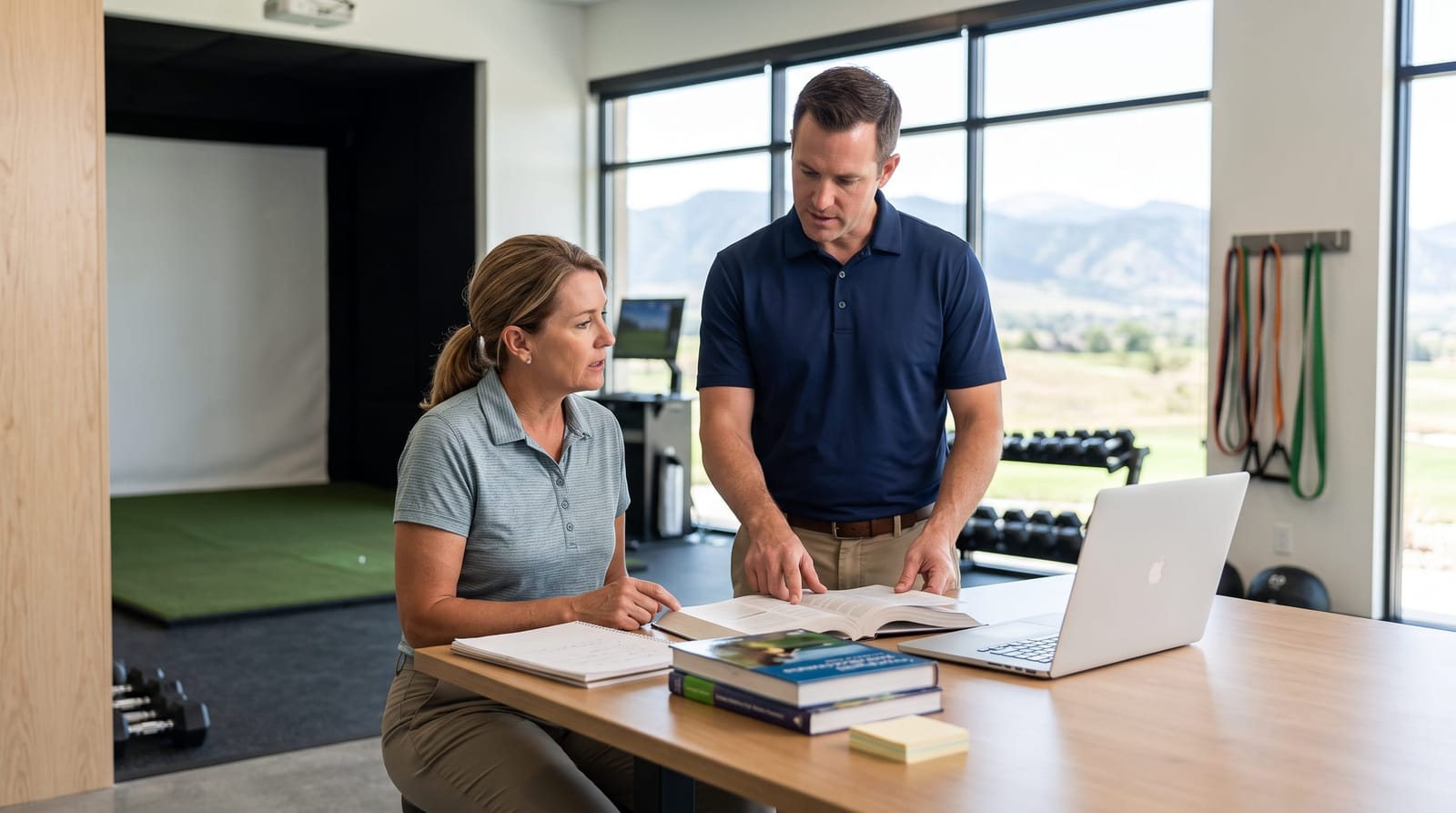
At Total Body Works in Colorado Springs, movement analysis helps identify exactly where your body is limiting your mechanics. Rather than guessing which muscles to train, you start with a clear picture of the mobility restrictions and strength imbalances that are specific to your swing. That kind of individualized assessment makes your training far more efficient than following a generic program.
Building Rotational Power: The Core of Golf Distance
Rotational power is the engine of your golf swing. But rotational core strength isn't the same as traditional core exercises like crunches or planks: it requires training your body to generate and control force through a twisting movement pattern.
Effective rotational strength exercises for golfers include:
- Cable or band rotational rows: These train your core to resist and produce rotation under load, closely mimicking the swing's power phase.
- Medicine ball rotational throws: Explosive side throws against a wall develop the fast-twitch power that translates directly to clubhead speed.
- Pallof press variations: An anti-rotation exercise that builds the core stability needed to maintain your spine angle through impact.
- Landmine rotations: A controlled, golf-specific movement that trains the rotational sequence from ground to upper body in a safe, progressive way.
The goal isn't just raw strength: it's the ability to generate power quickly and control it. Training this quality two to three times per week produces meaningful improvements in rotational velocity over time, which is the direct driver of increased swing speed.
Hip Hinge Mechanics: Where Ground Force Begins
Elite golfers generate power by pushing into the ground and transferring force upward through the kinetic chain: a concept sometimes called ground reaction force. The foundation of this movement is a strong, coordinated hip hinge: the ability to load your glutes and hamstrings, maintain a neutral spine, and fire explosively through extension.
If your hips are restricted or your posterior chain (glutes, hamstrings, lower back) is underdeveloped, you'll lose a significant portion of your potential power before the swing even fully loads. Training the hip hinge improves both power production and posture throughout your round.
Key exercises to develop golf-specific hip strength:
- Romanian deadlifts (RDLs): The foundational hip hinge movement. Builds hamstring and glute strength while reinforcing the neutral spine position you need at address.
- Single-leg RDLs: Adds a balance and stability challenge that mirrors the weight shift in your swing.
- Kettlebell swings: Develops explosive hip extension power and trains the fast-twitch response that contributes to clubhead speed.
- Hip 90/90 stretching: Improves internal and external hip rotation, reducing the physical restriction that forces compensatory movements in your backswing.
Better hip hinge mechanics also support your lower back during the repetitive rotational demands of a full round: a meaningful benefit for golfers who want to stay healthy throughout the season.
Shoulder Stability and Thoracic Mobility: Completing the Chain
Power generated in the hips and core has to travel somewhere, and it moves through your thoracic spine and shoulder complex. Restricted thoracic rotation forces golfers to over-rotate through the lumbar spine or compensate with their arms, both of which reduce power and increase injury risk over time.
Thoracic mobility work should be a consistent part of every golfer's training routine. Targeted drills include:
- Thoracic rotation in quadruped: A simple drill that directly improves the mid-back rotation your backswing depends on.
- Foam roller thoracic extension: Opens the mid-back through extension to counteract the forward-flexed posture many adults develop from desk work or driving.
- Open book rotations: Improves the dissociation between your upper and lower body, allowing for a fuller, more powerful rotation.
On the shoulder side, stability matters more than raw strength. Your shoulder needs to stay centered in its socket through a high-speed movement, and that requires strong rotator cuff muscles and scapular stabilizers. Exercises like face pulls, band external rotations, and prone Y-T-W raises build the shoulder resilience needed to support a consistent, powerful swing without placing undue stress on the joint.
If you're also training for other seasonal sports, many of these mobility and stability principles carry over: similar movement quality work is central to training programs for skiing and snowboarding fitness prep: how to train for Colorado's slopes, where hip stability and thoracic mobility are equally essential.
Putting It Together: A Training Approach That Fits Your Schedule
Golf-specific strength training doesn't require hours in the gym. A focused two-to-three-day-per-week program built around the movement qualities above can produce noticeable improvements in power, mobility, and consistency within six to eight weeks. The key is training with intention and progression: gradually increasing load and complexity as your body adapts.
A sample weekly structure might look like:
- Day 1: Power and Rotation: Medicine ball throws, landmine rotations, Pallof press, cable chops
- Day 2: Hip and Lower Body Strength: Romanian deadlifts, single-leg RDLs, kettlebell swings, hip mobility work
- Day 3: Shoulder Stability and Thoracic Mobility: Face pulls, rotator cuff work, thoracic rotation drills, open book rotations
Working with a coach who understands golf biomechanics and can perform a movement screen before you start ensures your program addresses your actual limitations, not just general fitness. Total Body Works uses movement analysis to personalize programming for golfers at exactly this level of detail, which makes the training more targeted and more effective from day one.
Frequently Asked Questions
How long does it take to see distance improvements from strength training?
Most golfers begin to notice improved swing feel and consistency within four to six weeks of consistent training. More measurable distance gains typically develop over eight to twelve weeks as strength, power, and mobility progress together. Individual results vary based on starting fitness level, training consistency, and how significantly physical limitations were affecting swing mechanics to begin with.
Do I need to be an avid golfer to benefit from golf-specific training?
Not at all. Golf-specific strength training builds functional strength, mobility, and rotational power that benefit casual and recreational golfers just as much as competitive players. If you play golf regularly and want to enjoy the game more, with less fatigue, better consistency, and more power, targeted training can make a meaningful difference regardless of your skill level or how often you play.
Can older golfers benefit from this type of training?
Absolutely. Recreational golfers over 50 often see some of the most significant improvements because physical limitations like reduced hip mobility and thoracic stiffness are common with age, and they respond well to targeted training. Building rotational strength and improving mobility supports not just distance but also longevity in the sport, helping you play comfortably and confidently for years to come.
Should I get a movement assessment before starting a golf fitness program?
A movement assessment is a valuable starting point for any sport-specific program. It identifies the specific mobility restrictions and strength imbalances that are limiting your performance, so your training addresses the right things from the beginning. Without that baseline, it's easy to spend time on exercises that aren't relevant to your individual needs, or to unknowingly reinforce existing movement compensations.
Building a More Powerful Game Starts Here
Adding yards to your drive isn't about swinging harder: it's about building a body that can generate, transfer, and release power more efficiently through every swing. By training rotational strength, hip hinge mechanics, core power, and shoulder stability, you give your swing the physical foundation it needs to perform at a higher level. Whether you're playing Valley Hi or a private course in Colorado Springs, a stronger, more mobile body translates directly to a more enjoyable and competitive round. If you're ready to take a structured, personalized approach to golf fitness, Total Body Works is here to help you build it.